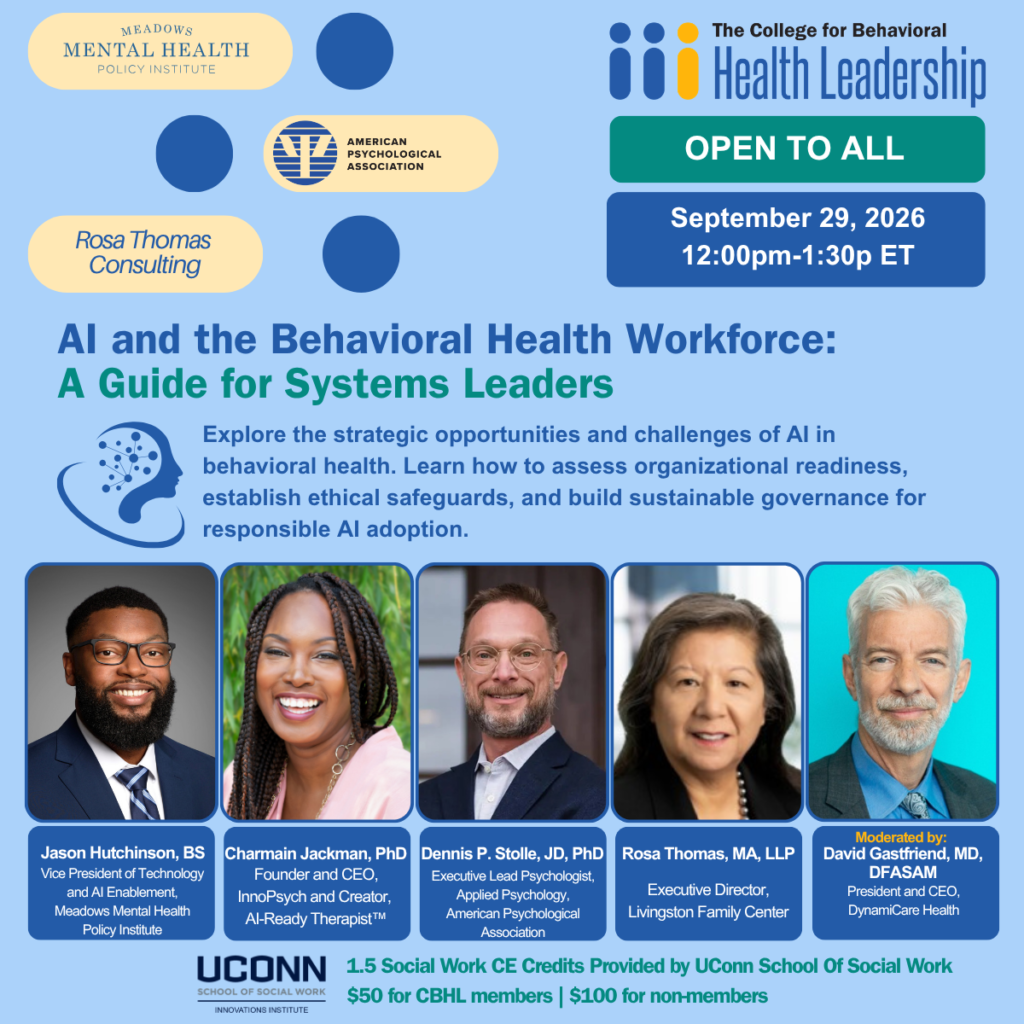
Tuesday, September 29, 2026
9:00 – 10:30 am PT / 12:00 – 1:30 pm ET
This event is free for all.
1.5 Social Work CE Credits Available ($50 for CBHL members; $100 for non-members)
Artificial intelligence (AI) is increasingly shaping how behavioral health organizations deliver care, support their workforce, and plan for the future. But for leaders, the question is how to adopt AI thoughtfully, ethically, and sustainably.
In this first session of the series, behavioral health leaders and organizational decisionmakers will explore the growing role of AI across the behavioral health ecosystem, from documentation, scheduling, and workforce training to clinical decision support and client engagement. Speakers will provide a foundation in key AI concepts while examining the strategic questions organizations should consider before implementing and scaling these technologies.
The session will explore organizational readiness, sustainable implementation and funding, governance and accountability, and the ethical and operational safeguards needed to support responsible AI use. Participants will also consider AI’s potential impact on clinical productivity, caseloads, workforce roles, and the skills and competencies teams need to navigate an increasingly AI-enabled environment.
Designed for executives, system leaders, policymakers, program directors, and other organizational decision-makers, this session will help participants move beyond the hype and begin identifying practical next steps for integrating AI in ways that support both the behavioral health workforce and the people and communities they serve.
AI-Readiness Quiz:
We invite you to complete a free 10-question, 2-minute quiz that shows exactly where you stand with AI before the webinar.
Link: https://www.aireadytherapist.com/quiz
Learning Outcomes:
Participants will be able to:
- Develop governance and accountability structures for AI use
- Implement organizational safeguards to support ethical AI adoption
- Identify and mitigate legal, ethical, and operational risks
- Assess organizational readiness and define next steps for system-wide AI integration
- Apply decision-making framework for evaluating and implementing AI solutions
Continuing Education Credits:
The University of Connecticut School of Social Work is approved by the Connecticut Department of Public Health to provide continuing education credits (CECs) for social workers. The School is accredited by the Council on Social Work Education. The University of Connecticut is regionally accredited by the New England Commission of Higher Education (NECHE). This program is eligible for 1.5 continuing education credits.
Speakers

Dr. Gastfriend is an addiction psychiatrist. At Harvard Medical School, he directed addiction research at Massachusetts General Hospital and was an investigator in the NIDA Cocaine Collaborative Study, NIAAA’s COMBINE Study and NIDA’s Clinical Trials Network. As Vice President at Alkermes, Inc., he directed scientific publications on Vivitrol in clinical, criminal justice and health economics research.
Read more
His research led most states to endorse the American Society of Addiction Medicine (ASAM) Criteria. His 150 scientific publications include the books The ASAM Criteria and Addiction Treatment Matching. His ASAM CONTINUUM – The ASAM Criteria Decision Engine ® and ASAM’s CO-Triage ® tools are being adopted nationwide.
In 2016, he co-founded DynamiCare Health, a nationally-scalable technology for Contingency Management and predictive analytics, winning awards from Harvard Business School, the Commonwealth of Massachusetts, the Governor of Ohio, and the New York Times. He has consulted to governments in Belgium, China, Iceland, Israel, Norway, Russia and the U.S.

Jason Hutchinson has six years of experience in solution architecture, software development, and technical strategy. Prior to joining the Meadows Institute, Jason was a lead developer at Genpact, a global professional services and technology firm specializing in Artificial Intelligence (AI)-driven business transformation. In this role, Jason architected and implemented enterprise solutions to solve complex business needs, co-founded the AI enablement function promoting the safe and efficient use of AI across business workflows, and partnered with stakeholders to define the technical infrastructure and governance needed to support data-driven decision making.
Read more
In his Meadows Institute role, Jason serves as the primary technology lead, responsible for defining and driving the Meadows Institute’s technology vision, AI adoption strategy, and systems infrastructure. He develops the organization-wide AI adoption roadmap, leads staff AI literacy and changes enablement initiatives, and serves as integration architect across the Meadows Institute’s core platforms.
Jason holds a Bachelor of Science in Software Engineering from The University of Texas at Dallas. He is currently in his final semester of a Master of Science in Computer Science, with a focus on Machine Learning and Artificial Intelligence, from The University of Texas at Arlington.

Dr. Charmain Jackman is an award-winning psychologist, TEDx speaker, and entrepreneur with more than two decades of experience at the intersection of mental health, leadership, and wellbeing. She is an emerging voice in the ethical integration of artificial intelligence into mental health practice and a founding member of the American Psychological Association’s Mental Health Technology Advisory Committee, where she advises on AI policy, practice standards, and equity considerations shaping the future of psychological care.
Read more
Dr. Jackman is the founder of AI-Ready Therapist™, a platform built to grow AI literacy among mental health professionals, grounded in her belief that technology adoption must center humans first. She is also the founder of InnoPsych, a mental health company expanding access to inclusive, stigma-free care, and the author of The Black Therapist’s Guide to Private Practice.
Her work has been recognized with the 2025 Boston Business Journal Innovators in Healthcare Award and the 2021 American Psychological Association Citizen Psychologist Award, and featured in Oprah Daily, NPR, and The New York Times. Dr. Jackman helps clinicians navigate AI’s transformative potential without losing sight of ethics, equity, or clinical judgment.

Dennis P. Stolle, JD, PhD leads applied psychology initiatives on APA’s Psychology Team, where he works to connect psychological science with the real-world needs of organizations, professionals, and communities. His work centers on translating evidence into practical tools that promote optimal psychological performance and well-being, with a particular focus on how people think, decide, and perform in small-group and team-based settings. A core part of this effort involves helping people, organizations, and systems learn—because learning is essential for growth, adaptation, and flourishing. His approach strengthens resilience, purpose, psychological capital, and psychological safety, all of which support high-functioning group environments.
Read more
Stolle’s applied work spans several domains. He has extensive experience in legal psychology, where he has advanced research on jury and judicial decision-making and advised legal teams on communication, strategy, and human behavior in high-stakes settings. He has also examined how psychological science can support the emotional and organizational well-being of legal professionals and institutions. His legal career included serving as a capital partner in an AmLaw 100 firm, where he worked on complex federal matters and developed evidence-based approaches to understanding how people deliberate, decide, and perform under pressure. He also founded and led a national consulting practice devoted to applied psychology in the legal domain.
His work also examines human–technology interaction, including the psychological implications of artificial intelligence, monitoring technologies, and digital systems. He has served in advisory roles in human-centered computing and frequently presents on how emerging technologies influence performance, trust, and the ways people understand and engage with their environments.
In addition, Stolle contributes to interdisciplinary efforts linking psychological science with environmental sustainability and conservation. He collaborates with scientific and conservation partners to explore how motivation, learning, resilience, and well-being support communities responding to environmental change, including through briefing policymakers and participating in initiatives focused on the human dimensions of environmental challenges.
Stolle earned his PhD in social and personality psychology, his JD from the University of Nebraska, and his BS in psychology from Saint Louis University. Across all areas of his work, he maintains a consistent aim: to help groups, teams, and organizations use psychological science to enhance well-being, strengthen decision-making, and create conditions where people and systems can thrive. His approach emphasizes the flourishing side of psychological functioning—focusing less on illness and more on human potential, purpose, learning, and performance.

Rosa M. Thomas, MA, LLP is a senior healthcare executive with more than 20 years of leadership experience across behavioral health, crisis response systems, and Federally Qualified Health Centers (FQHCs). She has led large-scale operational transformation initiatives focused on improving access, strengthening quality, reducing psychiatric hospitalization, and integrating behavioral and primary care within highly regulated environments.
Read more
Rosa holds a master’s degree in psychology with certifications in neuropsychology and integrated healthcare delivery. She played a key leadership role in the development and launch of Michigan’s statewide Crisis and Access Line (MiCAL) and was appointed by the Governor of Michigan to serve on the School Safety and Mental Health Commission. Her expertise spans clinical operations, regulatory compliance, workforce strategy, and system redesign within publicly funded behavioral health systems.
She completed executive certification in AI Strategies for Business Transformation at Northwestern University’s Kellogg School of Management. Rosa advises healthcare and nonprofit leaders on operational standard operating procedures (SOPs), governance frameworks, and human-in-the-loop models that integrate AI responsibly while safeguarding clinical judgment, compliance, workforce clarity, and sensitive information. Her work bridges executive strategy with ethical stewardship in care delivery.