Subscribe to Our Newsletter

  • Skip to primary navigation
  • Skip to main content
  • Skip to footer
The College for Behavioral Health Leadership

The College for Behavioral Health Leadership

Where behavioral health leaders collaborate to grow and transform communities across the nation.

  • About
    • Vision, Mission, Principles
    • Who We Are
    • What We Offer
    • Board of Directors
    • Staff
    • Thank you to our Sponsors!
    • Contact
  • Programming
    • All Webinars & Events
    • Workforce Solutions Jam
    • Equity-Grounded Leadership
      • Equity-Grounded Leadership Fellow Program
        • Funding Partners
        • Past EGL Cohorts
      • Equity-Grounded Leadership Executive Coaching Program
      • Characteristics of Equity-Grounded Leaders
        • The Principles of Change
  • Resources
    • Webinar Archive
    • Summit Archive
    • Healthy Behavior Change E-Guide
    • Journal Articles, Reports & Toolkits
    • Links
      • Health Equity and Anti-Racism
  • Membership
    • Why Join CBHL?
    • Membership Options
      • CBHL Membership Scholarship Fund
      • Give the Gift of a CBHL Membership
    • Organizational Members
    • Glue Up Member Community
  • News
  • Donate
    • CBHL Membership Scholarship Fund
    • Thank You to Our Donors

Search The College for Behavioral Health Leadership

Get Free Access to this Resource

  • This field is for validation purposes and should be left unchanged.
  • This field is hidden when viewing the form
  • This field is hidden when viewing the form
  • This field is hidden when viewing the form
  • This field is hidden when viewing the form

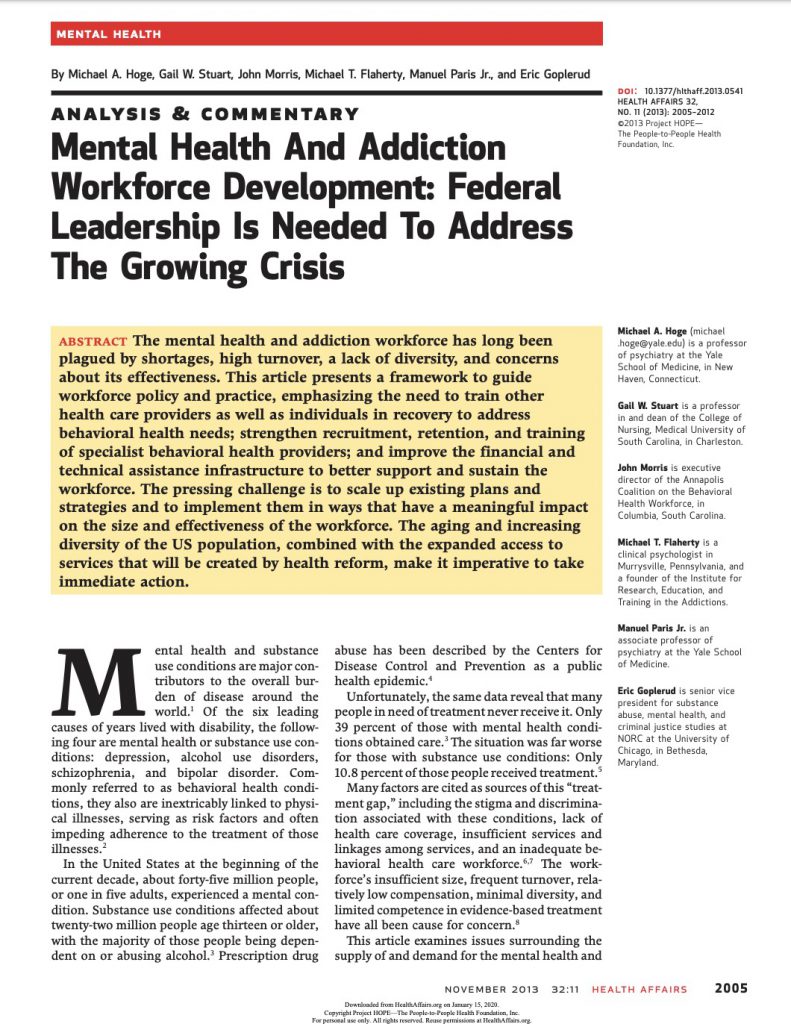
Mental health and addiction workforce development: Federal leadership is needed to address the growing crisis

By Health Affairs, 32 (11), 2005-2012, 2013. Authored by The Annapolis Coalition on the Behavioral Health WorkforceResource Category: Journal Articles & Commentaries

Download this Resource

In a commentary for Health Affairs, Michael Hoge and coauthors summarize the substantial and growing body of evidence that the current mental health and substance abuse workforce is seriously inadequate with regard to number of practitioners, lack of diversity in its composition and overall preparation. The authors recognize that, with a growing number of older and ethnically diverse Americans who are at high risk for behavioral health disorders, combined with the sheer influx of newly insured, the system is at a point of crisis. They call on the Federal government to scale up and actually implement already identified “broad strategies and specific actions necessary” to grow and strengthen the mental health and substance abuse workforce to meet the challenges it faces now and in the future.

Footer

Contact Us

info@leaders4health.org
9 Meriam St., Suite 4
Lexington, MA 02420

Connect with Us

  • LinkedIn

Join Our Mailing List

Key Links

  • Membership
  • Resources
  • About

Copyright © 2026 · The College for Behavioral Health Leadership · All Rights Reserved · Website by Tomatillo Design